

Does Claybrooke offer Life Insurance for Pre-Existing Medical Conditions?
Yes, Claybrooke does life insurance for Pre-Existing Medical Conditions at £10.83 per month for £270000 of cover.
During the life insurance application process, the insurance company often reviews the applicant’s medical information to decide on coverage.
Individuals with pre-existing health conditions often believe that acquiring life insurance is impossible, and even if they succeed, the policy will cost them heavily.
While it may seem unlikely, Claybrooke can find life insurance policies with competitive prices for those with pre-existing conditions.
Discover Providers Sympathetic To Pre-Existing Conditions – Quick Quote Form
Claybrooke has extensive experience helping clients with pre-existing conditions and can support this claim with years of experience in the field.
We pride ourselves on providing our clients with sound advice and independence that allows for the best insurance decisions, even though we work with many different insurance companies.
We have helped hundreds of clients obtain competitive, affordable insurance policies despite a wide range of pre-existing conditions they may have, including:
- Heart attacks
- Crohn’s disease
- Cancer
- Diabetes
- Epilepsy
- Multiple Sclerosis
Claybrooke can arrange competitive cover for these conditions as well as many others.
What Makes Claybrooke Different?
Claybrooke is an independent specialist in life insurance and pre-existing conditions.
Through hard work, we’ve gained an unparalleled amount of knowledge in the field, which we use to give clients the best possible advice and life insurance policies for their money.
We have worked with many different insurance providers and can identify which companies are the most competitive regarding different medical conditions.
This means our clients get an experience tailored to their particular needs.
How Much Will Insurance Cost for Pre-Existing Conditions?
After speaking with one of our staff, our clients with pre-existing conditions will be able to identify how Claybrooke can help them secure life insurance and receive a relative figure for how much a policy will cost, including coverage for their specific health condition.
If one or more of the choices presented to clients interest them and work for their lifestyle and budget, our team can help them apply for coverage through a suitable insurance company based on their specific condition and situation.
How Insurance Providers Calculate Cost for Pre-Existing Conditions
Each insurance company has its own way of determining the cost of insurance coverage for clients with pre-existing conditions.
Still, often the provider hires a medical underwriter to help evaluate the answers policy seekers provide on their applications.
The underwriter then decides whether there are enough details to provide a quote for a policy or whether the client needs to contact their general practitioner or specialist for more information.
Once clients have provided all required information, the underwriter can determine the monthly premium for the policy the client wants.
Many factors are considered when providers make this decision, and some of them include the following:
- How serious the client’s medical condition is
- How well the client manages his or her condition
- If there are any other medical conditions or concerns present
- The level of risk the insurance company will incur by insuring the client
- How many clients does the company currently have with the same condition as the client
- The level of experience the company has with the medical condition of the client
Much of the decision-making process regarding the cost of life insurance is connected to the individual’s medical information, the current state of his or her condition, and the specific insurance provider’s situation at the given time.
With that in mind, it’s easy to see why individuals with pre-existing conditions often seek assistance from companies like Claybrooke to find quality life insurance from a seasoned provider at a competitive price.
There are many examples of how some insurance providers can compete on one medical condition in one instance and not in another.
Insurance Provider A may offer extremely competitive rates for clients with diabetes for 1 or 12 months, but its prices change and become uncompetitive in subsequent months.
This often happens when an insurance company feels exposed to sufficient risks associated with clients with diabetes and adjusts premiums to limit future applicants and exposure.
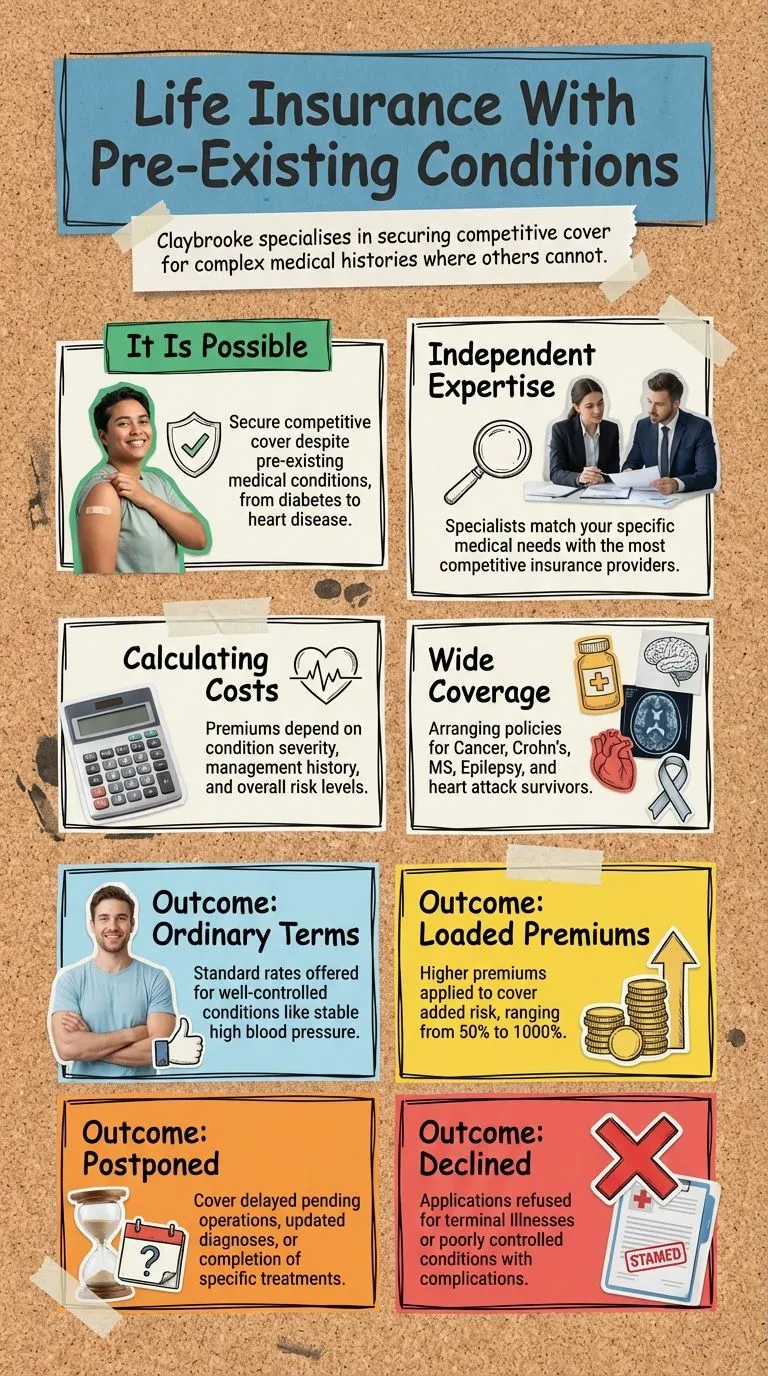
Possible Outcomes for Life Insurance Applications
After an applicant has applied for a particular product, the insurance company and the underwriter must do the required research to decide the applicant’s coverage.
Once the process is complete, the insurance company contacts the applicant to inform them of its decision.
An applicant may receive many possible options based on the insurance company’s findings during the research process.
Some of the potential options an applicant will see regarding his or her policy include the following:
“Ordinary” Terms Offered—This means that the insurance provider offers the client a policy with “standard terms” or the same terms it would offer clients without pre-existing conditions and in typical health.
This option is sometimes presented because the client has strong control over diabetes or high blood pressure.
“Loaded” Premiums Offered—This means that the insurance provider will provide coverage for the client but will charge the client a higher premium to cover the added risk of him or her claiming due to a medical condition.
The “load” added to the monthly premium ranges from as low as 50 per cent to as high as 1,000 per cent.
Some circumstances where this option is presented include the following: (1) history of cancer, (2) after a heart attack, (3) multiple sclerosis, (4) diabetes, and (5) Crohn’s disease.
Postponed Coverage—This means that, upon evaluating the individual’s application, the insurance company is not willing to offer coverage at this time but may be willing to offer coverage at some point in the future.
Some circumstances where postponed decisions occur include (1) applicants waiting for an operation or medical procedure, (2) applicants waiting for a new/updated diagnosis, and (3) applicants who are undergoing cancer treatments.
Declined Coverage—This means the insurance provider is unwilling to offer its applicant life insurance coverage based on the individual’s application, often because the company believes the risk to be too great.
Some reasons why insurance providers may decline coverage include applicants with terminal illnesses and those with poorly controlled diabetes with additional complications.

How Different Conditions Affect Life Insurance Coverage
Insurance providers categorise different health conditions to inform their decision-making when approving a life insurance application for someone with a pre-existing condition.
Rather than dividing conditions into columns or “buckets,” the Claybrooke team analyses each applicant’s situation to help him or her discover the best potential insurance coverage at a competitive price.
Click To Compare QuotesLet’s outline how a range of different health conditions are divided and how they can affect the insurance provider’s final decision about coverage for an applicant:
Conditions Accepted at “Ordinary Rates” or with Little Loading
- Arthritis
- Allergies (exception: severe allergies)
- Blindness
- Bronchitis
- Headaches (without underlying causes or additional medical testing)
- Hernias
- High blood pressure (controlled and stable with medication)
- Hypertension
- High cholesterol
- Hysterectomy (depending on reason)
- Indigestion
- Mild asthma (controlled with inhalers, not hospital treatments)
- Overweight (depending on the provider’s acceptable height/weight ratio)
- Skin disorders
- Well-controlled diabetes (conditions present for a number of years, under reasonable control with an HBA1c figure of under 7)
Conditions Subject to Loading Premiums
- Anaemia
- Angina (depending on the level of control)
- Ankylosing spondylitis
- Anxiety
- Atrial fibrillation
- Blood disorders
- Brain damage (wide range of loading–contact Claybrooke for more information)
- Brain haemorrhage
- Breast problems (cancer coverage may be available in remission after the qualifying period)
- Brittle bone disease
- Cancer (available for most patients in remission after the qualifying period)
- Cerebral palsy
- Colitis
- Coronary
- Crohn’s disease (ordinary rates or low loading for those in remission)
- Depression (ordinary rates may be available for mild depression)
- Diabetes (typical diabetes may secure a policy with moderate loading)
- Eating disorders
- Epilepsy
- Family history
- Fibroids
- Hemochromatosis
- Haemophilia
- Heart attacks (dependent on different factors)
- Heart disease
- Heart murmurs
- Hepatitis
- HIV
- Irritable bowel syndrome
- Kidney disease
- Kidney transplant
- Liver disease
- Lupus
- ME
- Mental illness
- MS
- Multiple sclerosis (dependent on type and severity)
- Myocardial infarction
- Obesity (available if general health is good)
- Pancreatitis
- Parkinson’s disease
- Sickle cell
- Stroke
- TIA’s
- Tumours (see information regarding cancer)
- Ulcerative Colitis (see information on Crohn’s disease)
- Urinary tract disorders
- Vein artery problems
Conditions Subject to Postponed Coverage
- Alcohol abuse (dependent on timeline and severity)
- Cancer (postponed during remission period–the length of postponement varies)
- Coronary
- Heart attacks (if the attack was in the last 12 months)
- Kidney disease
- Kidney transplant (may be available after the recovery period)
Conditions Subject to Declined Coverage
- Terminal conditions
- Uncontrolled conditions
- Multi-condition situations (ex. obesity with diabetes, heart conditions)
Remember, the information provided here is meant to be a guide to understand how various medical conditions are generally categorised by insurance providers and how these medical conditions can affect an individual’s life insurance application.